Friday, 30 March 2012

Super- subs!

The first proper rain in over a month brought some lovely fresh air to the morning. By 10:30 in light drizzle I was in a right tizz- I had seen 9 migrant passerines all as silhouettes and all flying away from me- I didn't manage to pin an ID on a single bird! Every time I moved around the ship and rounded an obstruction something was always flying off- so frustrating. Then it brightened up and the birds were gone! During the afternoon as we neared the coast of Libya things started to pick up again with singles of robin, kestrel, wheatear, and pied wagtail putting in an appearance. A small nervous bird then caught my eye. Initially I thought 'whitethroat' but I eventually pinned down a cracking male subalpine warbler. (30th positively ID'd bird species for the voyage- :))). This was joined shortly afterwards by two more- a second male and a female. A very jaunty chiffchaff tipped up 30 minutes later. Walking around some pallets on the deck I heard a thin, waderish- like 'pwee', and was treated to a flurry of wings as a quail burst into the air and circled the ship before heading north! Great stuff!

chiffchaff
As I have found out to my chagrin on numerous occasions, it is not possible to use any real 'fieldcraft' on the open decks of a ship. This means that although it is often possible to get close views of some birds, as soon as you lift a pair of bins or a camera they flit elsewhere. Unfortunately this was the case with the subalps. and so I only managed photos. of partially obscured birds- or rather distant shots.

subalpine warbler


Thursday, 29 March 2012

Risso's dolphins make a splash!

typical high, falcate dorsal fin

mature adult showing skin lightening and scarring

female with calf


Cracking weather again today with excellent sea conditions. 800 metres out I noticed a high, sickle-shaped dorsal fin break the sea surface during one of my many binocular sweeps. Five minutes later a nice school of Risso's dolphins (Grampus griseus) swam across our bow. As far as I could determine there were a dozen or so- eight or nine adults, including at least two mature males and two or three smaller calves. They closed to within 400 metres of the ship, allowing me to get a few shots off. Mature adults are renowned for their pale skin and scarring- particularly in the head region and the scarring is caused from multiple previous encounters with other sharp-toothed individuals and, to a lesser degree squid.  This species also shows a good deal of variation in the height and shape of their dorsal fins. The individuals here certainly showed these characteristics rather nicely. After watching them for 10 minutes they gradually moved off to the east and were lost from view in the heat haze.

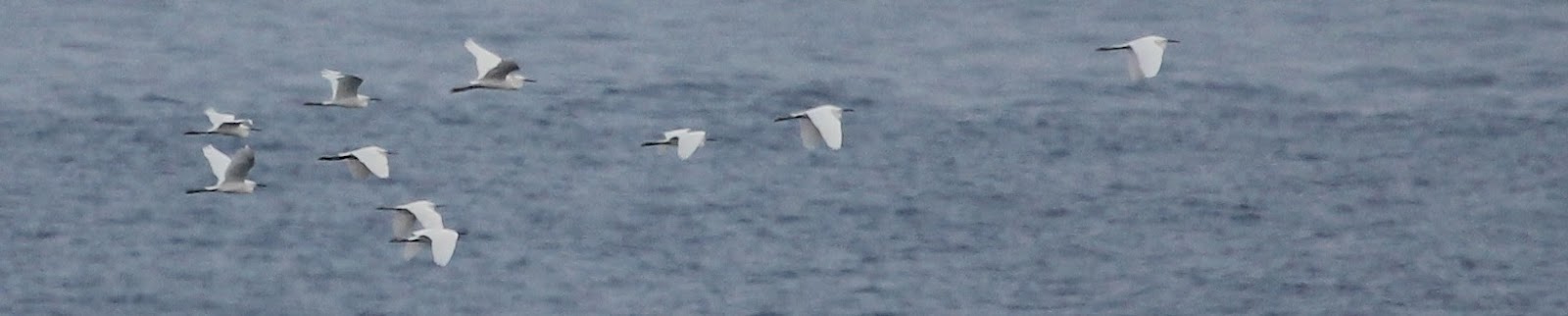
On the birding front a wheatear was a first for this voyage and a nice flock of 10 (Little?) egrets looked resplendent despite the distance, with their pristine white plumage making for a lovely contrast against the  sea!


Tuesday, 27 March 2012

'Sunday'- Monday; 'crew change'- Tuesday

sunrise 26/03/2012
sunset 26/03/2012 
Yesterday was dire with the exception that I saw an ocean sunrise and sunset- and absolutely nothing in between these two celestial events. Birds just didn't appear to move in the oppressive heat. I cowered behind factor 30, shades and a wide-brimmed hat. Visions of water droplets sliding down cold beer bottles kept annoying me all day.

Today was crew change day- for some, and as expected for such a day, it was cooler, windier and with a hint of drizzle in the afternoon. The drizzle didn't stop the smiles from those homeward bound though! They even boarded a fancy new offshore crew-change vessel with airline style (business class!) seats, air-con and personal mini t.v. screens. (And it goes at 20+ knots!)


Anyway, I had to console myself with the fact that I probably have another 3-4 weeks at sea so grabbed several choccy biscuits and just cracked on with my work. There were no signs of marine mammals anywhere so I was drawn to feathers again. The day saw 9 tern sp. flying north but too distantly to identify. On deck briefly were singles of pied wagtail, blackcap and a fleeting serin. I also got a photo of a redstart sp. and having given it much scrutiny I am wondering if it is good for a moussier's redstart? (anybody care to make a shout?) It appears rather short-winged, the tail seems short- although admittedly it is rather worn, the flanks seem rather more rufous than on a common redstart and there is a hint of a pale wing panel? Maybe I am just being overly optimistic? - and it doesn't really matter- it's a nice bird whatever!


Sunday, 25 March 2012

Sylvia's a fit bird!

It has been rather better from a birding perspective over the last two days. The wind dropped and the dust settled yesterday, prompting the 3 resident blackcaps to head north once again. A swallow followed shortly afterwards and a few of the cory's stopped loafing and resumed their endless search for food particles on the seas' surface. Today started nicely with two great skuas, 3 med gulls, and a dozen or so LBB and YL gulls recorded during the morning. At lunchtime a tern sp. flew across the ships' wake but remained rather too distant for me to confirm my suspicion that it was of the whiskered variety. Another swallow, a redstart, a kestrel and a lovely sardinian warbler visited the ship for varying amounts of time today, with the kestrel and swallow doing swift flypasts, the redstart momentarily alighting and the warbler staying for 40 minutes or so- catching flies and moths. This bird took a real interest in fly catching from the pedals of a static exercise bike and even managed to take a moth that was a real beak full.  To be honest this fit little bird spent more time on the exercise bike than many of the people onboard and probably the less said about that the better!

pedal power.....makes me hungry..
just one more snack...


I have no idea what type or species of moth this is but they are constantly flying about the ship and have been useful sustenance for many of the passerines that have stopped off during their northward passage.


Friday, 23 March 2012

The Ghibli

The last three days have seen us subjected to a rather awful SE wind, sweeping up from the Sahara. Known as a Sirocco (or Ghibli in Libya) It results in dry, dusty conditions along the north African coast, sometimes creates storms in the Med. and makes for unsettled weather in southern Europe. Although not too strong, at a steady 22-26 knots, it has been annoyingly breezy, (if I had hair it would be blowing in my eyes!). Although the sun is intense, conditions on deck have been uncomfortably cold and very very dry. My nose and throat feel ragged as though stuffed with wire wool and my exposed skin is sore from abrasion by the fine dust and sand particles suspended in the breeze. Feather wear in migrants must be considerable when they are exposed to such conditions!
I had thought the Ghibli would push a few migrants my way but the only birds seen over the last 72 hours have been 3 Blackcaps and these have stayed onboard catching flies and hiding out of the breeze. They   do appear rather reluctant to resume their northward passage despite the fact that we have come about and are now heading south again! Maybe more migrants are attempting to avoid these harsh conditions where possible and are hunkered down along the shoreline waiting for clearer air? On the seabird front I have recorded only 3 Great skuas and a distant Larus sp.
Being at sea, surveying seabirds, is normally a source of great pleasure- when there are birds to identify and count!- but when it is this quiet the days are tedious and very very long. I have found myself thinking of where I would like to be birding this weekend and top of my list is Portland Bill or Dungeness- trying to anticipate where those scarce migrants are going to turn up! 


One of our temporarily resident blackcaps caused me to do a double take this morning due to its' coloration - then I realised that it had been dust bathing and had gone for a very fetching 'Sahara pink' outfit. Perhaps it fancies itself as a bit of a Bullfinch!


Thursday, 22 March 2012

Manic morning

large falcon coming out of the sun!
I stepped on deck in the early morning light to be greeted by a Little egret coming up from the south and flying high over the ship. Five minutes later a large, pale falcon sp. came out of the sun like a well trained fighter pilot, went hurtling past the bridge at ridiculous speed and re-appeared some 300 metres ahead of me and just kept going NW- gone in 10 seconds! I toyed with the idea that I had just glimpsed my first ever Lanner?, but I must admit to not really having a clue and don't think I'll ever knowA swallow bravely followed in its' flightpath several minutes later. 
Sea watching was great too! 3 nice lines of shearwaters- 26 Cory's and 5 Balearics came down wind and I also recorded 4 great skuas, 2 gannets, 3 Med. gulls, 4 LBB gulls, and a yellow-legged gull. A distant humpback whale (Megaptera novanglea) was a great distraction for over an hour as it breached repeatedly and lunge fed at the surface. Several schools of tuna sp. also provided additional interest. Then it was 10:00 hours and time for coffee and cake!

large, pale falcon just kept going!
The afternoon was spent watching the shearwaters as they danced over the waves!

Sunday, 18 March 2012

Race row?

A quiet weekend with Saturdays' only birds of note being a couple of Balearic shearwaters. Visible migration turned up a couple of LBJ's that remained unidentified due to distance and sunlight in my face. Today was a little more interesting- my early morning sea watch turned up 2 gannets, 2 great skuas, 3 Cory's and the usual larus suspects. Two passerines briefly boarded the ship- a robin and a rather splendid yellow wagtail which alerted me to its' presence with a nice overhead flight call. It landed on the most inaccessible part of the ship, hence the distant photos- grrrr.


Now, I don't intend going off on one, concerning the identification of the numerous races of these splendid birds (because it has all been covered elsewhere) except to say that initially I thought this was a 'thunbergi'. However, looking at it closely it has a white, sub-moustachial stripe (admittedly not too apparent on my wretched photos) and this I believe is a characteristic of the 'cinereocapilla' race found in Italy? I readily admit to struggling with the finer I/D points of wagtail races and would welcome any input on this. When all's said and done it's always a pleasure to see these birds as they are scarce in the north and as I have not seen one on my local patch these birds are a bit of a treat!


Friday, 16 March 2012

The doldrums


I was rather disheartened during the morning, as with a flat calm sea I saw a further 5 migrant corpses floating past- including a larger bird that looked like a kestrel. I'm surprised that such a strong flyer ended up drowning, and have little hope for many of the much smaller, weaker birds that tried to negotiate the sea crossing during the recent bad weather. Anyway with such little breeze today, most of my seabird counts consisted of loafing Cory's and the usual larus sp. gulls sitting about on the sea. With minimal seabird action and fine conditions I had great hopes for some vis mig goodies but this was also rather limited with just 6 Stonechats and a flock of 12 duck sp. heading north. 

All the stonechats adopted the same strategy in that they each dropped onto a part of the ship, hung around for 10 or 15 minutes catching flies and small moths and then resumed their northward passage. At least we were steaming north at 5 knots so it felt good to give them a helping hand! 


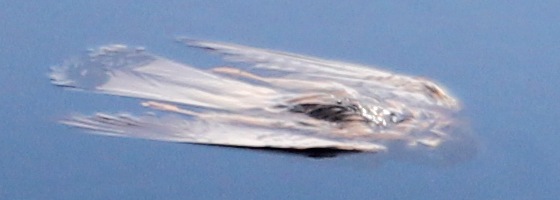
With such unusually calm conditions it was possible to see into the water and admire a few medusae so I tried a couple of snaps to pass the time.