Sunday, 14 April 2013

vis mig flurry

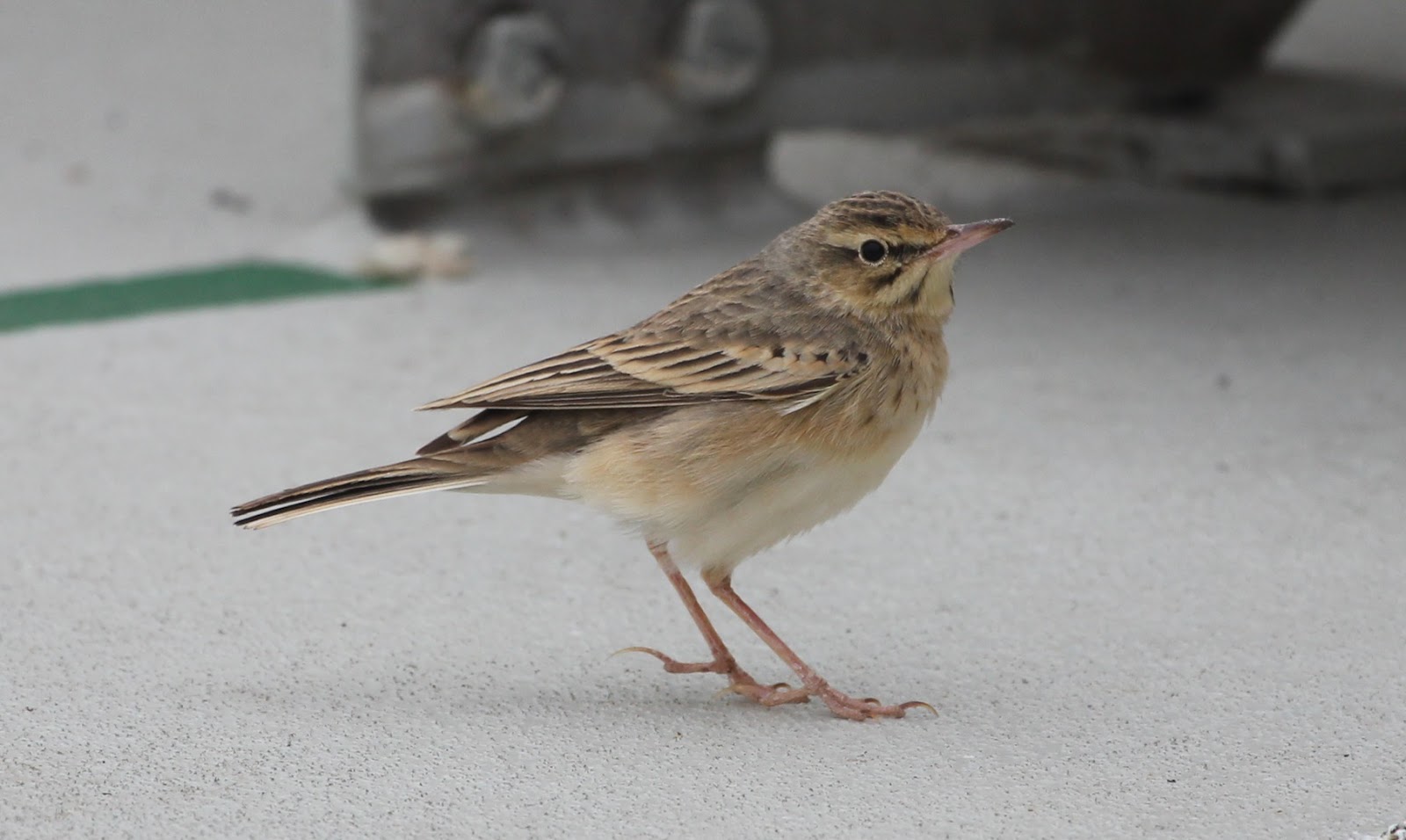
It has been quiet of late with just the terns obviously flying north. Today was better with a kestrel, 2 turtle doves, 2 collared doves, a very nice garden warbler and a pipit sp. I think it is probably a very worn and abraded (from the desert sand) tree pipit? The pink bill looks right and the hind claw is relatively short but in truth I struggled to ID this one. I often struggle to ID birds on a ship- the habitat gives no clues!

I have been at sea for sixty days and am due off in 2 or 3 days time- can't wait for a cold beer and the chance to get back to the British isles for some quality spring birding!

16.04 update- thanks to Kriss Webb (Scilly spider), and Paul Stancliffe (BTO migration blog) for IDing the pipit as a Tawny

garden warbler

Tawny pipit

turtle dove

collared dove

kestrel

Tuesday, 9 April 2013

a lesson learned

Having made a big sweeping statement on a recent post as to how the cory's tend to avoid close passes with my vessel, the inevitable happened today with several birds coming in to 50 metres or so- the first of several occasions during the day when mother nature put me firmly back in my place!
arctic skua
I had a great day today and recorded 11 species of seabird- Cory's shearwater, gannet, LBB gull, YL gull, arctic skua, great skua, common tern, sandwich tern, black tern, sabine's gull, kittiwake. There are now thousands of sandwich terns in the survey area and I presume many of these are now resident as opposed to passage birds. They are particularly impressive in the late afternoon when they gather in large flocks to feed on the shoals of sardines. This provides ample ambush opportunities for the growing number of arctic skuas too. The black terns were definitely passage birds and the first I have seen moving north this 'spring'.
 
Having spent several hours on the seabird melee I was just thinking that I don't see many seabirds in this part of the ocean that really challenge my IDing abilities anymore, unless they are very distant (or juvenile gulls!). I was continuing to self-assess and starting to feel quite good about myself when a small grey-white-black seabird went fast across the bow and sheared hard and fast down wind- mother natures slap back number 2! I could not decide if it was a probable phalarope or maybe a white-faced stormy!
 
Having consoled myself that not being able to ID one seabird was not too bad, a few minutes later I got my come-uppance again when I noticed a tern that was obviously bigger and heavier than a sandwich flying purposefully north. Having got on it with the trusted opticrons it showed a massive orange-red bill but flying away I couldn't get anything else on it in the late afternoon light so had to leave that one un ID'd too- slap back No. 3! I think I may have missed an opportunity to ID a lifer in the shape of my first ever Royal tern?- or was it a wayward caspian? With the current weather systems I would not like to guesse! Anyway, serves me right for getting cocky and forgetting that after 40 years of birding I still learn something new every time I look at our feathered friends!
 
common tern
 

arctic skua
 
cory's shearwater
 
 
sandwich tern
 

Sunday, 7 April 2013

super sabs.

3 days of awful weather including 6-7 metre swell and a nasty Beaufort force 7/8 has made conditions onboard pretty difficult for all concerned. Although I do not suffer from sea sickness I do get tired from the constant vessel motion- especially as it has been so rough that there has been a danger of being thrown out of my bunk on occasion! Anyway, a brilliant bonus of the NW gale was the arrival of a flock of 7 Sabine's gulls- a great surprise and a species I was not expecting this far south and east. The birds looked really comfortable in the high winds and seas- they are so obviously an oceanic species when viewed under such conditions. As can be seen below I really struggled to take photos. in the bright sunshine, 28 knot winds and from the heavily rolling vessel. I'm not too bothered though, as it was such a treat to see these delightful gulls. All tiredness was forgotten for the few minutes that they spent around the ship. 


with sandwich tern

Thursday, 4 April 2013

cory's move north

It has been very quiet over the last week or so, with persistent NW airflow halting any anticipated vis. mig. The exception to this being an increase in sandwich terns, with the largest daily count of 80+ birds flying into the wind. A couple of distant flocks of duck sp. have also been observed flying north. Yesterday the wind finally changed direction and has been blowing consistently from the SW. This seemed to spur the cory's shearwaters into action. Yesterday I recorded 40+ birds throughout the day and this afternoon I counted 94 birds past the ship in 3 hours- all moving purposefully north. I never tire of watching these splendid ocean wanderers. This species never seems as comfortable as great shearwaters when it comes to flying past the ships that I am on, and they rarely approach closer than 150 metres or so. This makes them quite challenging to photograph but I'm fairly happy with some of the snaps I took today. Hopefully more goodies will follow!


Thursday, 28 March 2013

white-faced storm petrel

With breaking news of the black-throated thrush in Aberdeenshire I was in a fairly miserable mood this morning as another target bird for my British life list is sure to flit before I get home and have a chance to twitch it. I consoled myself with arctic skuas and sandwich terns and then enjoyed a few common dolphins as they did a fairly close pass. After lunch the sun came out and it quickly became unbearably hot. Squinting into the sun I saw a small distant splash, a hint of a light grey shape, another splash and I thought I was watching a flying fish. Seconds later what looked like a tiny kangaroo bounced down the side of the ship and I realised I was watching a white-faced storm petrel! They really are the most delightful birds- probably one of my favourite seabirds and I never tire of watching them as they use their incredibly long legs and feet to spring off the sea surface as they search for tiny food items. Unfortunately, as is so often the case with such encounters, the bird stayed out at 100+ metres from my ship so my photos. are very heavily cropped although they just show enough detail to confirm the ID. A very nice consolation bird!!


Saturday, 16 March 2013

Vis mig update

Things have been quiet over the last week with persistent NW Beaufort f4/5 winds. This morning it was all change with a light (f2) easterly, occasionally veering to the south-east. In two hours I had 3 swallows, 2 sand martins, a redstart sp. and a phyllosc. sp. fly past the ship. On the deck were 3 pied wagtails including a splendid 'Moroccan wagtail- subpersonata' (note the damaged feet/missing toes). Flitting about the deck were also at least 4 subalpine warblers. Everything on the deck resumed northward flight after briefly feeding on the numerous flies and moths that had been buzzing about. Later I saw a couple of lark sp. and 4 swifts did a very fast pass!

pied wagtail- ssp. subpersonata


subalpine warbler

Monday, 11 March 2013

a very tasty sandwich

Not much to report on the migration front with stiff NW winds currently halting the passage of passerines, with the exception of a solo swallow. A few pom skuas and several arctic skuas have been noted pushing north but unfortunately they have all been rather ship-shy and not been close enough for photo. attempts. Sandwich tern passage remains fairly steady with a dozen or so recorded most days. One individual did a wonderful close pass and allowed me to get some decent flight shots- a very nice bird! The real highlight however was a raft of grey phalaropes- I watched them resting and apparently feeding on a surface slick for 5 minutes or so before they resumed their northward flight- cracking birds! Aside from that I have been treated to a good number of common dolphins swimming around the vessel.


distant raft of grey (red) phalaropes


Wednesday, 6 March 2013

Leviathan

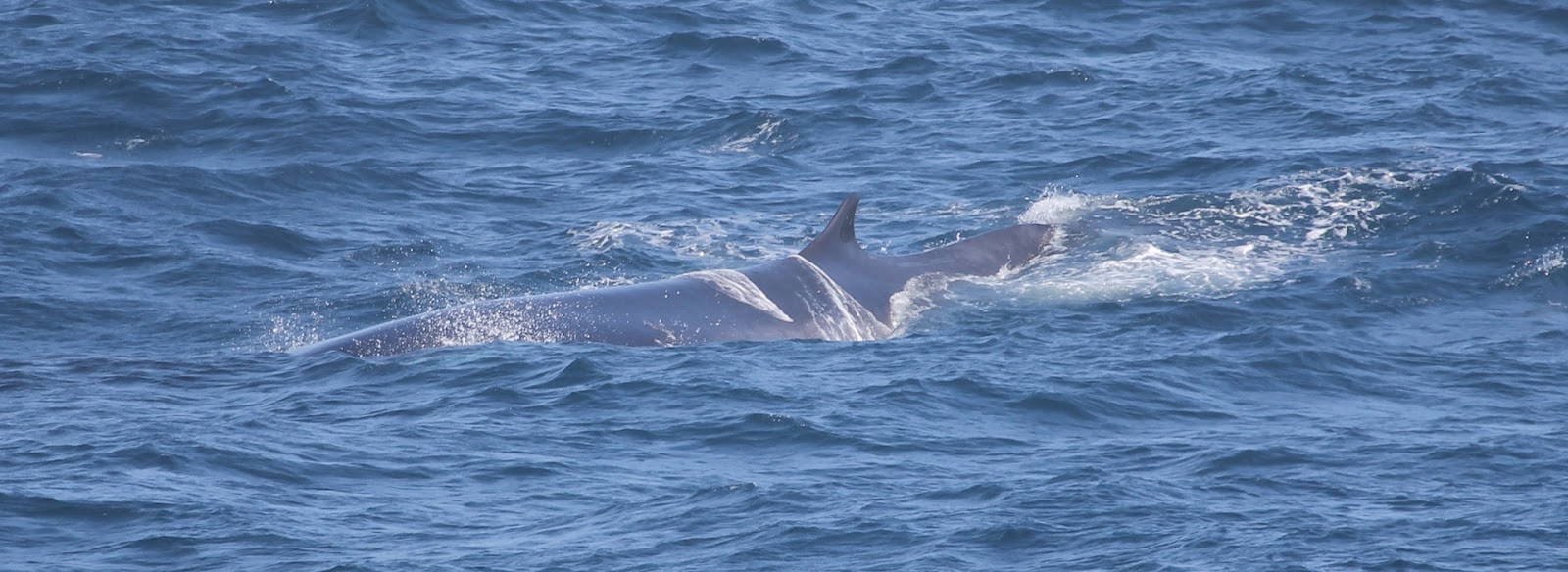
I have been very fortunate to see a good number of Fin whales over my years at sea, however today I was very lucky to see a true leviathan- an adult specimen that was probably approaching the maximum overall length of 27 metres that is generally accepted as about the upper limit for this species and second only to the mighty Blue whale in the size stakes!  The whale came within 400 metres of our vessel during our slow passage north in 6 metre swell and put on a bit of a show as it cruised past- simply magnificent!