Showing posts with label Great shearwater. Show all posts

Thursday, 19 November 2015

Cape Verde shearwaters

Some years ago (I'm too polite to say exactly how many) a group of intrepid birding greats including the likes of Tony Marr, Dick Newell, Richard Porter and Robin Jolliffe undertook a series of pioneering trips to Dakar, Senegal. These very capable birders embarked on a series of pelagic trips and recorded thousands of the fabled Cape Verde shearwater (Calonectris edwardsii) in the waters off Senegal. Additional, impressive passage counts of more familiar species such as Sabine's gulls and Pomarine skuas were also recorded. Years later, the immense potential for superb sea watching off Senegal continues to steadily gather momentum. 

Over the past few years I have spent a number of occasions with Tony, sea watching at the Butt of Lewis. During our many birding conversations we often discussed the possibility of me finding the  elusive Cape Verde shearwater, whilst undertaking my numerous surveys off the West coast of Africa. Despite much time scrutinising sea birds off the likes of Morocco, Mauritania and further south Gabon and Ivory Coast I have never managed to find one of these birds. Over the last week I have been working off Senegal and have enjoyed watching Cory's shearwaters on a daily basis- a few birds may have been candidates for Scopoli's shearwater  and I have also seen two great shearwaters and a solitary Manx shearwater. A few days ago whilst studying the Cory's I noticed some 'large shears' that although superficially resembling Cory's, appeared a tad smaller and slimmer (by about 10%?). These birds appeared slightly stiffer-winged, and possibly had slightly faster wingbeats- I'm trying not to string anything here! With better views the birds appeared to have more chocolate brown tones to the head as opposed to the generally diffuse greys of the Cory's. These birds also have more brown on the underwing. In certain light conditions the birds appeared rather 'capped'- something the Cory's never showed. Upon closer scrutiny it was apparent that the birds had thinner, grey bills although this has proven difficult to utilise as a useful field characteristic except when the birds ventured very close in and under very good light conditions. Generally though, the lack of a typical Cory's massive, yellowish bill can be a useful indicator under the right circumstances and with birds that 'cooperate'! With increased practice I have managed to pick up a few birds at greater distances, based on the faster flight action and generally slimmer/darker jizz, although readily admit it is not easy! Having managed a few photographs I was delighted to see that they were indeed Cape Verde shearwaters- a seabird 'lifer' for me. 


Identification is fairly straightforward at these distances! 


Sunday, 16 August 2015

A trio of boobies.

A good week for boobies- although only observed in low numbers, this juvenile red footed booby makes it three species in 5 days. Having done the obligatory 'eat the flying fish' routine it decided to settle on a mast allowing for some portrait shots to be taken. I have also had a brief visit from a bottlenose dolphin and a distant frigate bird sp. Some autumnal bird migration has started with a few more pomarine skuas, a single great shearwater and several distant wader spp. all flying south. Hopefully something unusual will pass within range of my lens before too long! 


Thursday, 5 September 2013

Black country blues

Thanks to a 3 hour Aer Lingus flight delay in Cork I missed my connecting flight home so have to spend a night in a rather seedy Birmingham airport hotel......won't mention the name in case they take legal action but the initials are H.I. - can't believe I had to wait in my room for 4 hours while they sorted out a problem with the electronic door key- eventually I demanded a different room! Anyway, a chance to post some final snapshots from my Porcupine sea bight survey ( and have a beer or three!). Hopefully I will make it home tomorrow and get back to some much needed local patch birding.

long-finned pilot whales 
one of my last recorded Cory's- simply stunning!
a delicately dancing great shearwater
a nice comparison- fulmar & great shear
common dolphin- underwater shot!

Tuesday, 20 August 2013

Shear delight

After a few days of fog and light, variable winds, the forecast of a reasonable blow with a significant westerly element raised my pulse rate and guaranteed that I was on watch early the following morning. I was not disappointed, as two great shearwaters flew 100 metres or so off the port bow as I gathered my waterproofs, hat, notebook and binoculars from the bridge! From then on and over the last three days I have enjoyed three figure counts of great shearwaters, intermingled with scores of Cory's! Some birders would say that when you have seen one large shear you have seen them all, but I disagree, find them totally captivating and have no problem watching them shear and glide over the swell and waves for hours on end. Surprisingly, and contrary to the large numbers of sooty shearwaters reported from Irish sea-watching sites, I have only seen one in the last 3 days- maybe they hug the Irish coast more as they drift SE? I also had the bonus of seeing flocks of Sabines' gulls- a group of 3 and a group of five. Unfortunately being on a 92 metre vessel, with a GRT of over 9000 tonnes means that many birds are rather ship-shy, occasionally however, a large shear made a relatively close pass, allowing me to try for a couple of shots. Good numbers of Arctic and 'comic' terns have also been seen flying south and an additional grey phalarope and a turnstone have been the only other obvious passage birds. I suppose we should see some significant skua passage before too long, but with the exception of a solo, spoon-laden pom and a few locally foraging bonxies they have yet to make an appearance. Happy days!

great shearwater- close pass at last!
Add caption

Cory's - unusually close in!
brilliant birds!

Thursday, 15 August 2013

Bad light stops play

Day three of rain and rolling fog banks with severely reduced visibility has stopped all seabird observations with the exception of a close pass by a storm petrel. Not a gannet or fulmar in sight. Heres a few snaps I took earlier. (The whimbrel flew overhead heading south before the weather turned)

whimbrel on migration
great shearwater
manx shearwater
manx & great shearwater

Friday, 9 August 2013

The Porcupine Seabight

The Porcupine Seabight is an interesting oceanographic feature located a hundred or so nautical miles  WSW off the southern coast of Ireland. It is a large depression where the water rapidly deepens and leads out to the abyssal depths of the North Atlantic. The strong ocean currents form nice areas of nutrient-rich upwelling so there is often an abundance of marine life- plankton, shoals of pelagic fish including albacore and yellow-fin tuna, cetaceans and seabirds- at least that is what it said in the tourist brochure! In all honesty there have been good numbers of fin whales- sometimes 5 or 6 in a day, the fishing fleets of Ireland and Spain are actively fishing for tuna, but seabirds have been rather scarce. Admittedly I see gannets and fulmars every day but numbers are low. A few lesser black-backed gulls have followed the survey vessel on occasion and I have had good days where I have seen four species of shearwater- Great, Corys, Sooty and Manx- but again numbers have been disappointing. I have also see a few bonxies, 2 Sabines gulls- both magnificent adults in summer plumage a few storm petrels and 1 wilson's petrel- I can't complain but I hope that numbers increase over the coming weeks! Unfortunately I have struggled with poor light and distant birds so taking photographs has been challenging, although this morning a great shearwater came within 40 metres of the bow, allowing me to rattle off a few snaps. Hopefully the sunshine and a nice Fea's or Bulwer's petrel are not too far away! 

great shearwater
great shearwater
nice flock of manx shearwaters
manx shearwaters- incredible how the light affects the plumage tones!


Thursday, 1 August 2013

Great, Cory's and Wilson's- when lifers don't count! :(

Joined my survey vessel yesterday in a nice little port in the SW of Ireland. We steamed down the river Shannon, then overnight on the open sea. This morning I awoke over the Porcupine sea bight WSW of Mizen head in about 1600 metres of water. I spent the morning working and getting organised and then spent 3 hours on watch this afternoon. It was very quiet aside from a few gannets and fulmars and a solitary great skua and a fly-by turnstone. The sea was choppy but not unduly so, however the watch was made difficult by intermittent heavy rain and rolling damp fog banks that left water droplets on everything. The light was dull and everything had a soggy feel to it and as there was not much about I didn't bother taking the camera out onto the deck- then things changed for the good with 4 great shearwaters, a Cory's shearwater and a Wilson's petrel flying past the bow of the vessel in quick succession! Although I have seen thousands of both of these shearwater species and scores of Wilson's I have not seen any of these 3 species in British waters and so all 3 are needed for my 'British list'! Of course having checked my position on the nautical charts I confirmed my worst fears in that I am working in the Irish sector- by a significant margin! The moral of the tale is always, always have the camera ready and also too consider starting a British and Irish life list! The camera (in a plastic bag) will be on deck for the rest of the voyage!

Sunday, 30 June 2013

Pelagic visitors

Not much happening on the seabird front- the usual smattering of Cory's shearwaters, two great shearwaters in 2 days and a probable Royal tern did a fairly distant fly past. We have had a couple of rays (probably mantas) and a turtle swim past as well, so at least I have had a few photo. opportunities. Three days to go then I am heading back to the NW highlands of Scotland to get up to speed with some terrestrial birding.


Sunday, 29 July 2012

River life- Surinam style

Wednesday I did a small boat transfer onto the support vessel 'Maria G' for a 24 hour steam to Paramaribo, Surinam. A chance to catch some well needed sleep and do a bit of leisurely sea watching!


This is one of the few remaining great shearwaters in the area- I suppose this individual is waiting for  it's new feathers before playing catch-up with the rest of them off Greenland. I really like the effect of moulting in these birds with every feather so clearly defined......

moulting great shearwater


A few hours into the transit we were lucky to have a visit from 4 spinner dolphins that took some delight in bow riding for 20 minutes or so.....


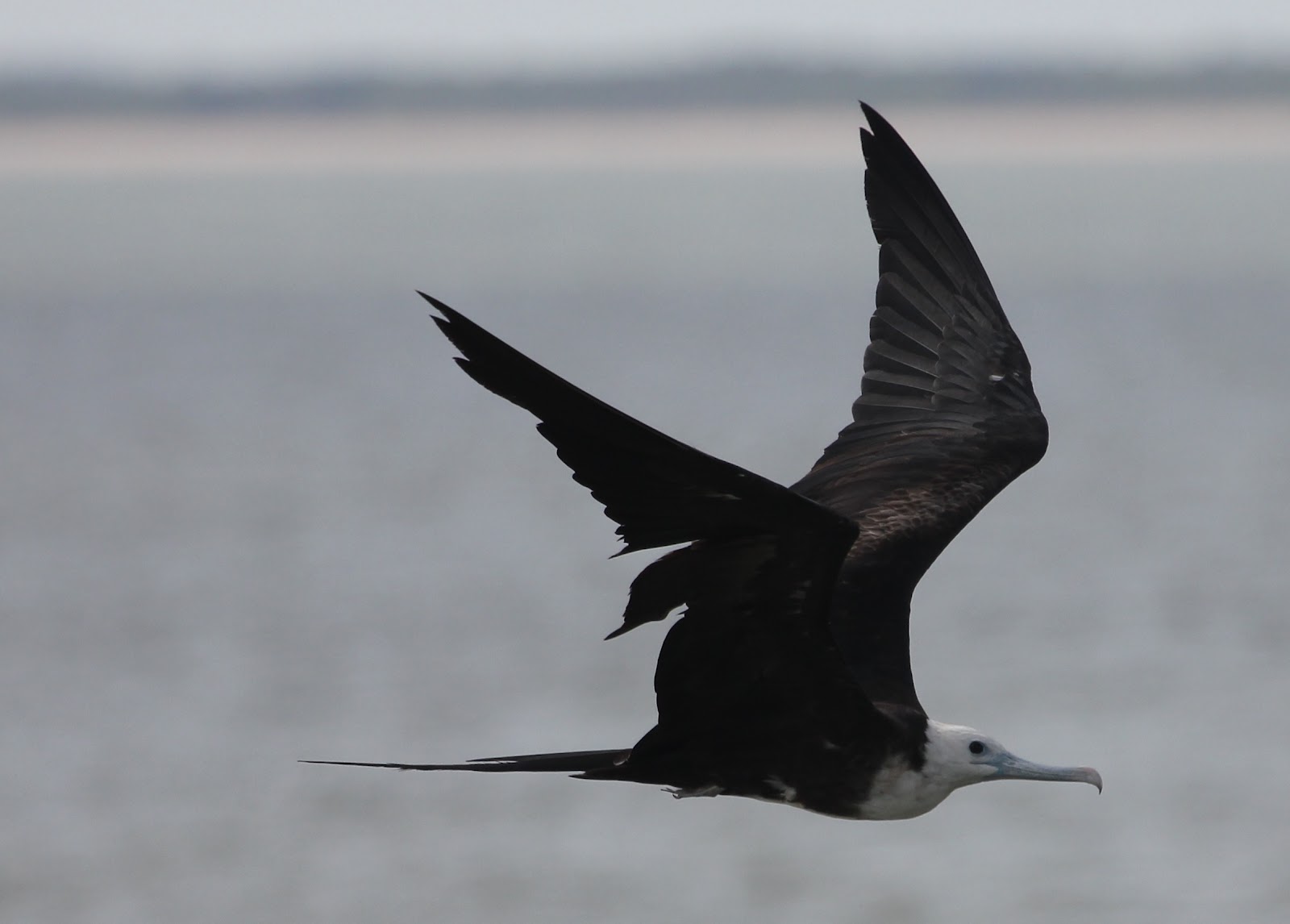
The following morning we entered the river system for the final 2 hour journey up to Paramaribo. A chance to see trees at last! I is quite strange how much I miss the colour green after 5 weeks at sea. Plenty of birds about too, with raptors, terns, frigate birds and a variety of herons all showing nicely over the river. We also saw the Tucuxi river dolphins again although they were rather distant. Although not exactly attractive the birds the frigates were certainly magnificent!

magnificent frigate birds


Quite a bit of fishing activity too- both of the inshore subsistence type and larger vessels working offshore and commercial traffic utilising the high tide to get in and out of Paramaribo.

offshore fishing vessel

rich pickings for the terns and local fishermen

river barge
boats at the fish wharf, near Paramaribo
After over a month at sea the air and vegetation seemed full of birds- mostly distant but still a delight to see...just wish I could name them all!


later after a hotel rest stop, I headed for the airport for the 10 hour flight to Amsterdam, then on to Aberdeen before finally arriving home in Ullapool after travelling for three and a half days. Beer and local patch time time!