Saturday, 23 February 2013

Moroccan delights

Not much to report on the sea bird survey although the species list is steadily climbing with the addition of kittiwake, great skua and sandwich tern.  Although I have also had repeated distant views of shearwater sp. and storm petrel sp. they remain very elusive and as yet I have been unable to get a positive ID on any of them. We are surveying in an approximate west-east orientation and during the east-end work we are only about 5 miles offshore. This has provided some lovely views of the Moroccan coast and the beautiful snow-capped Atlas mountains- the first time I have seen snow on the African continent.
Agadir with snow-capped Atlas mountains beyond.
close pass to the shore south of Agadir- where desert meets sea!
Being so close to shore has allowed a number of uninvited guests to jump aboard, including a collection of bugs, beetles, grasshoppers and moths. 
hawk moth sp.
grasshopper or locust?
We also had a very nice view of a loggerhead turtle as it swam past the vessel.

Loggerhead turtle
kittiwake

Tuesday, 19 February 2013

Barbary falcon?

Bit of a treat yesterday morning when a medium-size falcon came flashing over the sea, circled the ship twice, then settled on a support beam under the heli-deck. The flight was powerful and dashing and initially when seen I thought peregrine although the bird seemed rather more refined. Anyway, a raptor expert I am not- especially concerning new African species!,but having shot off a few frames I think this bird could be a barbary falcon. I would be delighted if someone/anyone reading this post could advise me differently if that is the case. Aside from the ID challenge it was a delightful moment to see the bird on the ship. Having plucked and eaten its' breakfast, the bird flew off, was momentarily harried by 3 LBBG's and then flew NE towards the coast just north of Agadir.

Edit-footnote 28.02.2013- had a nice email from Hugh Insley (highland recorder) and LGR Evans (UK400) today, confirming this bird as a 1st year Barbary falcon. Many thanks gents!


Saturday, 16 February 2013

Audouin's gulls

Just arrived on my survey vessel about 20 nm offshore Moroccco. I get occasionally views of the distant coastline through the heat haze and there is a steady succession of vessel traffic moving to and fro from the port of Agadir. 

Plenty of distant gulls to keep me occupied and the occasional close pass from a gannet or two. This morning I saw a line of 7 small shearwaters, although I could not get anything on them to even suggest an ID although I suspect balearic. Highlight so far has been great views of Audouin's gulls- the adults are particularly splendid as they fly above the ship. Hopefully I will get some better 'side-on' shots over the forthcoming days. 


Saturday, 9 February 2013

Kerb-crawling in Norfolk!

Just had a flying visit to Thetford, Norfolk to attend a training course at BTO H.Q. in the Nunnery. Naturally this meant some opportunistic birding during my 3 day visit. On the first morning whilst walking from the hotel to the course venue I was lucky enough to get great views of an otter. A short while later in crisp, still air I enjoyed a few minutes with the long-staying black-bellied dipper- just minutes from the BTO H.Q.


black-bellied dipper, Thetford


Over the next two days despite being indoors for most of the time I managed a few year ticks- jay, green woodpecker, lesser black-backed gull, red-legged partridge and marsh tit being the highlights- all these birds being practically impossible to get in the NW Highlands of Scotland! Incredible as it may sound the marsh tits were my first record of this species in nearly two decades! Sadly, although heard calling, I failed to see any nuthatch- another bird not seen by me in years.

Having completed the course on Friday, I planned to finally get to Wolferton on Saturday to catch up with a much needed lifer- Golden pheasant. I was on site at about 08:40 and drove slowly around 'the triangle'. This was pretty bizarre birding and soon felt a tad stressful- constantly checking the roadside verges, whilst also watching the rear-view mirror for fast moving cars. I made 4 or 5 slow circuits, each time having to negotiate pulling back onto the main 'A' road to get to the other side of the woodland. My initial euphoria quickly evaporated as no birds were seen and the whole place seemed incredibly busy with 'non birders' who looked at me as if I was a criminal as they drove past. I made one last circuit before thinking that a major dip was on the cards- a country gentleman walked along the verge towards me with two black labs that appeared to take great delight in putting their noses in to every patch of undergrowth. I pulled into a small muddy lay-by where I could watch a good length of verge and also partially view a small woodland clearing. 

Wolferton triangle
A couple of birders pulled up behind me and quickly informed me that it was too busy and that I was wasting my time. I couldn't be bothered to ask them why they were still looking if I was wasting my time! They drove off after 10 minutes or so. I sat and waited and tormented myself with the idea of walking through the woods. I know from speaking to plenty of other birders and from site reports that this is a major no no, so at 10:30 I reluctantly gave up and drove over to Holt to visit Cley spy to buy a bit of birding kit and cheer myself up. Having bought my new binocular strap I decided to head back towards Thetford. Plan B was to look for a caspian gull. On a whim I decided to re-try for the goldies so headed back to the excitement of the muddy lay-by. By now I couldn't be bothered with more kerb crawling so just sat on the bonnet with bins and camera and intently watched the sunlit verge ahead of me. After only two minutes or so a common pheasant walked across the road. Things were looking up. As a car came up the road the pheasant disappeared into the thicket. This happened twice more in the next 30 minutes or so. A car came slowly towards me and stopped alongside. Following a brief discussion with the two occupant birders about having seen nothing of interest they informed me that I should have been here 'this morning' as two male goldies were on the verge at the 'other end' at 08:15.......grrrrrrrrrrrrrrr. I gave it another 10 minutes and realised I was getting close to going crazy and running through the woodland like a loony. I decide to admit defeat so got in the car to drive to the village of Wolferton- 30 seconds later a stunning male goldie trotted out of the undergrowth about 50 metres ahead of me!! What a bird!! I checked the mirror, saw a car coming up behind, pulled into the verge and shot off a couple of frames through the car windscreen. As the car came rushing up behind me, the bird bolted into the undergrowth and was gone. My photos are dreadful but who cares?- a much needed lifer and 20 seconds of birding joy made the whole day so worthwhile! 

footnote: having been told that the 'universal binocular strap' fits all, I found out on my return to Thetford that it does not fit my beloved opticron DBA oasis bins! The joys of birding...... 

fuzzy golden pheasant!

blurry golden pheasant

Tuesday, 5 February 2013

white-winger

Following last winters major influx of Iceland gulls I was rather hopeful of a similar number of interesting gulls this winter. Unfortunately, to date, there has been no noticeable arrival. I have not recorded a single white- winged gull thus far this winter. The recent west, nor-westerly storms however seem to have pushed a few birds into the western coasts. Following a telephone tip at lunchtime today I went home to get my camera and then headed for Ullapool harbour to take a few snaps of the reported 1st winter glaucous gull. It may not be too pretty but it was certainly a very welcome white-winged brute and the first record of this species in Ullapool for many a year. 


Monday, 7 January 2013

Desert campaign

I finally managed a long overdue twitch to Rattray head, Aberdeenshire with Richard Rafe in order to see the Desert wheatear. Leaving the village at 04:00 got us on site to witness a lovely dawn after seeing a very welcome barn owl enroute. On arrival it was a little too dark for active birding, so we had 30 minutes enjoying the sunrise and listening to the calls of pink-footed geese as they flew overhead. With improving light we headed for the dune slack to look for our target bird.

dawn over Rattray head
the 'light in the sea'
After my initial panic at not finding the bird around the dune pool, I decided to walk a couple of hundred metres along the tide line towards Peterhead, whilst Richard checked the dune system. A robin flew from the seaweed into the dunes and in the half light I initially thought it was the wheatear. Retracing my steps, I re-checked the flooded area- again without success, so I continued along the high- tide line past the lighthouse. A few minutes later the wheatear flew from a patch of flotsam- the black tail and white rump patch very distinctive in the morning light. It was good to see the bird actively catching sand flies and looking very at home in its' pseudo desert environment! We enjoyed good views of this very nice bird and it proved to be well worth the travel. 


Later we caught up with a drake King eider on the sea off St. Combs and I also got another dozen or so common species to push the year list up to 74. Another great day in the field.

Friday, 28 December 2012

The velvet touch

Poor weather has prevented me from travelling east to twitch a couple of interesting rarities and so I have spent time working the local area. At this time of the year I rely heavily on gulls, grebes and divers  and the occasional sea duck to brighten the short dark days. It was a real bonus to find two velvet scoters in Ardmair bay about 3 miles north of the village. Although not considered a great rarity, these birds are very uncommon along the NW coast. I trolled through my old field notebooks and realised that I have not recorded this species here for a good number of years! The session also turned up a slavonian grebe, 7 great northern divers, 1 black-throated diver, 3 little grebes and a few goosander and red-breasted mergansers. The velvet scoter were diving for crustaceans about 30 metres out from the shingle beach and by waiting for them both to dive I was able to walk down the shingle to get a couple of snaps even though the light was very poor. Nice birds for the local area!


Saturday, 22 December 2012

Kernow birding

Just back from family pre-xmas visits in Bristol and Cornwall (Kernow). It's a long way to travel from the NW highlands of Scotland so I always incorporate some rather intensive birding along the way. Having done my bit in Bristol, it seemed an ideal opportunity to head up to Slimbridge WWT to catch up with the long staying long-billed dowitcher. It was a bright, cold, frosty morning as I headed up the M5 and I made good time, arriving at the visitors car park at 08:10- an hour and twenty minutes of daylight to use before the WWT opened at 09:30. I spent the time getting my scope and bins ready then enjoyed the varied flocks of wildfowl flying overhead. Birds were everywhere, something that always takes a while to get used to after a spell in the avian desert of the NW highlands! Having eventually got into the reserve, I was miffed to find that the hide to the south lake was closed for refurbishment- this had not been mentioned when I had rung up to enquire about access a few days before my visit. This was a serious blow as the LBD had often been seen from that location. My chances of connecting with the bird had been reduced by 50% and I immediately set off under a dark cloud to see if it was viewable from the alternative hide that overlooks the tack piece. The fresh wind was bitterly cold and blowing straight in my face as I carefully worked my way through the several thousand waders and wild fowl. I just started working through a flock of godwits in anticipation of getting on the LBD when a buzzard flew in and flushed everything- the godwit flock flying off high towards the south lake with no sign of my target bird. I had the all too familiar 'dipped out' feeling and trudged off to the Zeiss hide where as if in compensation I had great views of a bittern standing out in the open in bright winter sunshine. Of course I had opted for scope rather than camera so a cracking photo. opportunity went begging. I re-checked the tack piece with no sign of the LBD and as it was now late morning I headed out of the reserve to begin my drive to Cornwall. I watched a flock of geese land in a field next to the overflow car park so decided to have a quick look. I quickly got onto a small number of (european) white-fronts, and a dozen or so Bewick's swans. As I turned around I noticed a flock of waders in the opposite field so started working through them with the scope- unbelievably I got onto the dowitcher some 30 seconds later! I enjoyed the bird for 15 minutes or so before the whole flock was flushed and flew off to the south. I was a happy birder as I headed down the M5. Traffic was light and I made good time so had a quick look at Mounts Bay before heading to Helston. 

Over the next four days I spent innumerable hours working through the divers in Mounts bay before I finally got reasonable views of the Pacific diver. Having seen it a couple of times distantly, I was finally satisfied with views that I considered were good enough for me to add this to my life list- especially as it was associating closely with 3 black-throats that offered good comparisons. I also recorded dark-bellied brent goose, velvet scoter and common scoter, great northern divers and two very nice little gulls. Between intense scope sessions I wandered around the Marazion marsh where my best find was a firecrest- a cracking bird in my book! I also got on to a cracking black-necked grebe at college reservoir, Falmouth.
snipe- Marazion marsh
grey heron- Marazion marsh
Further time was spent at the Helston water treatment works near the boating lake and also at the Loe pool. I was pleased to find a black redstart, at least a dozen chiffchaffs and two more firecrests at these sheltered locations. The light was generally poor but I did scrape together a few photos.

black redstart- Helston sewage works
It was great to see so many chiffchaffs competing for the flies around the settling tanks. A blackcap was another bird I don't normally see in the winter months.

firecrest- Loe pool, Helston
a wee cracker!
The weather kicked off over the next few days so birding was difficult but I managed coastal walks on the lizard and at Pendeen watch. I decided not to go for the sub-alpine warbler in St. Just, as looking into peoples gardens is my least favourite type of birding. The lizard provided reasonable views of a chough and there were plenty of kittiwakes and common guillemots heading west past Pendeen watch.

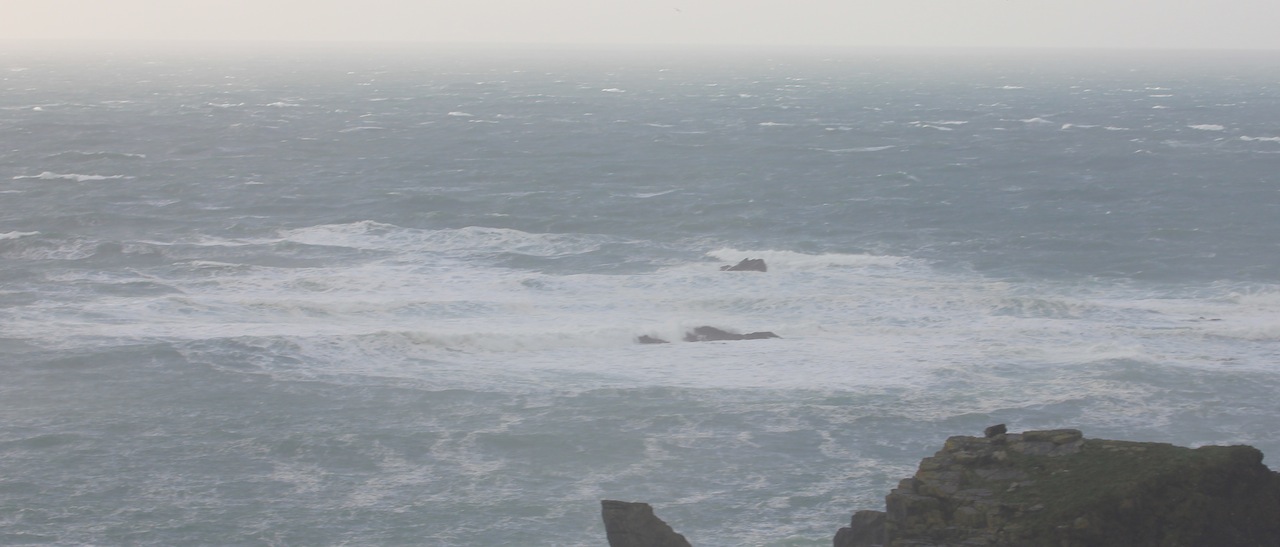
rough seas off the Lizard

chough- Housel bay, the Lizard
Guillemots over rough seas at Pendeen watch
I decided to stop off in Exminster for the rose-coloured starling on my drive back to Bristol airport. I was just about to give up on the bird after waiting in the churchyard for over 2 hours when it flew up from a non-viewable garden and skulked in the tree tops for a minute or so before disappearing from view.

1st winter rose-coloured starling- honestly!
 All in all an excellent trip- some great birds seen and the family kept happy as well!